Sunday, 12 October 2014

Cyclical Themes

One of the ideas that I came up with over the summer, was this idea of a circular rig that will constantly revolve around one protagonist. This protagonist would be subject to a plot with a cyclical theme.

This was inspired by Quentin Tarantino’s “Pulp Fiction” as Bruce Willis stands in a phone booth whilst the camera pans 360˚ around his conversation. 


The fact that we wanted to work with a cyclical theme to complement the camera movement meant that we were set up for a challenge in scriptwriting. Since having a cyclical theme and plot means there’s very little room for a three-act structure, we turned to Adam Bloom (an alumni writer from BA (Hons) Film Production) for help.

We discussed the idea with him and we were given the draft screenplay for “Last Call.” It follows the story of a basket case father, revealed to be in trouble, making one last phone call to his son before he commits a robbery. It was written well, but unfortunately the entire screenplay felt like a scene in a feature film. With this at mind, we decided not to go with Adam Bloom’s script.

At the moment the concept still remains unresolved and without a script. I will most likely explore this idea as an artistic side project, as opposed to a narrative.


Documentary Idea – Germany’s Graffiti Subculture


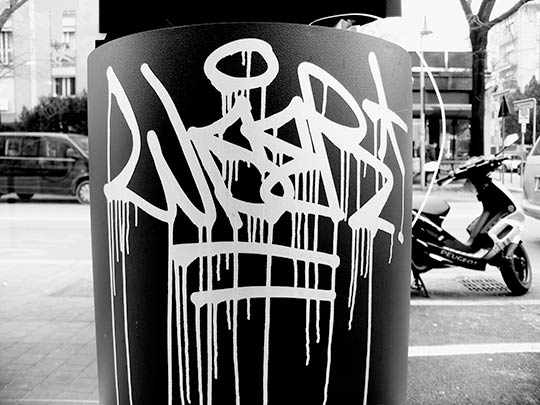
I used to have connections to members of a German graffiti crew, and was taught some of the basic rules of graffiti etiquette. These rules were extremely fascinating, and included the following:

  • Paint the town as much as you can, the more you tag or paint, the more dominant your crew seems.
  • Your tag cannot replace a “throw up.” In the same way that your “throw up” cannot replace a mural. Every design that is created can only be replaced with something bigger, or else the design of the perpetrator will be regarded as disrespectful.
  • The ultimate form of achievement comes in the form of bombarding a train with a mural. This is incredibly risky, therefore respected. 

An example of a "tag." 

An example of a "throw up" covering "tags," but unfortunately also covered in "tags."
This would be considered disrespectful in Germany. 

An example of a mural.

A "throw up" on a Deutsche Bahn train.

As a fellow artist, I thought that this would have a brilliant topic to pursue, especially when I have the beginnings of a network for it. I would have wanted to pursue with the following questions:
  • What are more examples of graffiti etiquette?
  • What is it like to be a part of a crew?
  • What happens when you get caught in Germany?

I feel like the listed questions will vary according to each country. For example, being a part of a crew in America has been seen as a means of “survival,” an example of which is shown in the following documentary:

"Infamy" a documentary on graffiti in the USA.

Since Germany is quite a strict and developed country, I feel that being in a crew is not just for a “means of example,” and is far more expressive in a country that is quite socially oppressive.

As a result I pursued this topic with my lead, but unfortunately it has come back negatively since my lead has left the crew lifestyle behind. I’ve been referred on to more people through the graffiti network but most are quite paranoid about being caught on camera, which is why it’s been difficult to confirm an interview into their lifestyle.

For now, until a serious lead comes up as interested in an interview, I will be keeping this project on standby.

Adapting Jacob Hobbin's "The Garden of Eden"

I have had six year’s worth of experience in theater. My roles have ranged from
acting, set decoration, lighting, sound, filming and stage-managing. It is from
these experiences I find that I also enjoy film production and piecing a
narrative together.


Over the summer I was put in contact with Jacob Hobbins, a budding playwright for
theater. I was shown his play, “The Garden of Eden” over YouTube:


After watching his play I was completely swept away by the emotions involved with his
work. As someone who has personally dealt with sexual harassment, I really
connected the protagonist in his story. On top of that, I had a great sense of
appreciation for the visual metaphors that were present, such as the courtroom
as a setting, the apple and the personification of the snake. The references
that Jacob Hobbins made towards Adam and Eve, turned out to be a brilliant way
to question our idea of “the truth” behind the night in question. Is it really
Eve’s fault?

I contacted Jacob Hobbins, asking if we could potentially collaborate. When he
agreed, I asked him for his inspiration. The news articles about the 2013 rapes
occurring in India were referenced.  

I got to work on converting his play into a screenplay, which turned out to be a
difficult task. Some of the following problems surfaced:


  • In theater, hyperboles are accepted to deliver a message. On screen it would come across as bad acting
  • There is a lot of visual instruction in the dialogue (since setting is limited to one stage), which once again will come across as bad acting.
  • Personification of the snake would be difficult. Since Jacob used a lot of sibilance in the attorney’s dialogue, this would have been awkward and out of character to deliver on screen. Theater will always reserve the right to incorporate some fantasy and the imagination, which is what film lacks.
  • The entire play demonizes men, which I didn’t entirely agree with. For the sake of the plot it could be great, but as a producer I feel that I hold the ultimate responsibility for what I’m creating and publishing.

In the end, it was agreed that either I find a scriptwriter that would know how to
translate the play into a screenplay, or that I move on from this project. I
decided that it was best to avoid creating a film that would not do the play
justice.

Third year starts here.

This is just a marker post, to signify that everything after this post is for my final year of BA (Hons) Digital Film and Screen Arts!